From RV Parks to Motorcoach Resorts: Why America’s Homes-on-Wheels Economy Is Becoming a Hospitality Business

hotel forecasting software may sound like a tool designed exclusively for conventional hotels, but many of the same forecasting principles are increasingly relevant to the sprawling American economy built around recreational vehicles, RV parks, campgrounds, and upscale motorcoach resorts.
The connection is not as unlikely as it first appears. A traveler pulling a 35-foot fifth wheel across Arizona may bring the bedroom, kitchen, and living room along for the journey, but that traveler still needs somewhere to stay. The property providing the site must manage reservations, seasonal demand, utilities, staffing, maintenance, amenities, and pricing. In business terms, there is considerable overlap with hospitality.
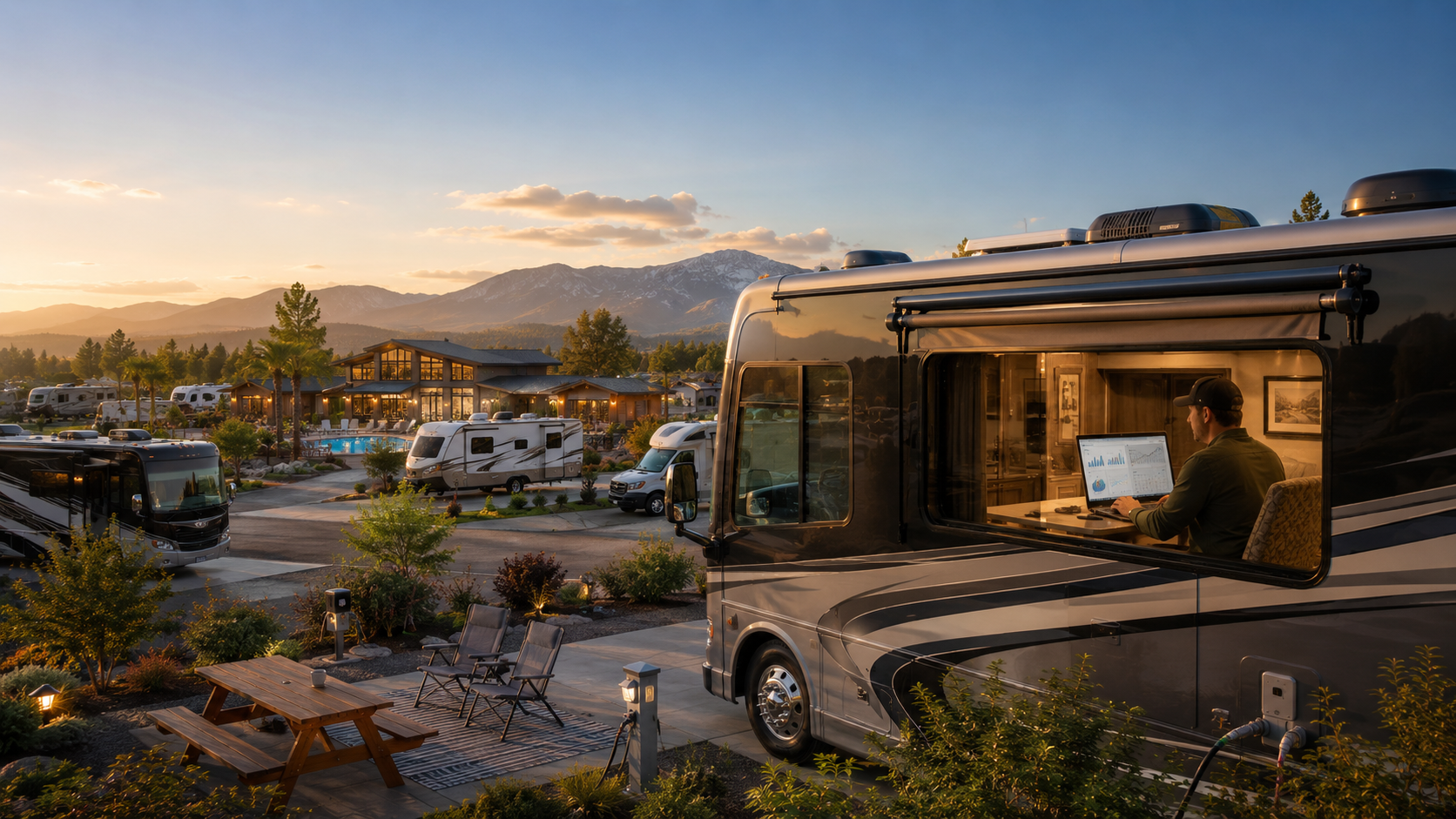
That overlap has become more important as American RV travel has diversified. The old image of a basic campground with a gravel pad and electrical hookup still exists, but it now shares the market with destination RV resorts offering swimming pools, clubhouses, fitness facilities, landscaped sites, organized activities, dog parks, and other amenities associated with leisure hotels.
A Home That Travels Still Needs a Destination
Few forms of travel are as distinctly American as taking a home onto the highway. Motorhomes, travel trailers, camper vans, and fifth wheels allow travelers to change locations without repeatedly packing suitcases or checking into traditional accommodation.
Yet mobility does not eliminate the need for infrastructure. It shifts that need elsewhere.
An RV park effectively sells a temporary piece of usable space combined with access to services. Depending on the property, those services may include electricity, water, sewer connections, Wi-Fi, laundry facilities, security, recreation, and access to shared amenities.
Once viewed from this perspective, the similarities with lodging become obvious. An empty RV site tonight is much like an empty hotel room: the opportunity to sell that inventory disappears when the night is over.
This makes occupancy forecasting particularly important.
The RV Park Is Becoming a More Sophisticated Business
For decades, many independent campgrounds could operate with relatively straightforward management practices. Owners knew their busy weekends, understood local tourism patterns, and adjusted rates occasionally.
That model becomes harder to sustain as properties grow larger and customer expectations rise.
A modern RV resort may have several categories of sites with different prices. Premium locations might offer additional space, better views, private patios, upgraded landscaping, or easier access to resort facilities. Some properties also rent cabins, tiny homes, cottages, or glamping units alongside traditional RV spaces.
Now the operator is no longer managing a single product. The business has multiple inventory categories, each with its own demand patterns and operating economics.
There may also be substantial ancillary revenue from convenience stores, propane sales, equipment rentals, food service, laundry, events, or recreational facilities.
Financial planning quickly becomes more complicated.
Seasonality Can Define the Entire Year
Geography has an enormous influence on the economics of American RV properties.
A campground near a national park may experience extraordinary summer demand followed by a dramatic slowdown once temperatures fall. Properties in Florida and Arizona can face almost the reverse pattern as winter travelers arrive from colder northern states.
Then there are destinations influenced by festivals, sporting events, school holidays, fishing seasons, local fairs, and major highway traffic.
Operators therefore need to think beyond annual revenue totals. A property can be profitable over twelve months while experiencing considerable variation in cash flow from one season to another.
Forecasting helps management anticipate these swings rather than simply reacting to them.
| Business Variable | Why It Matters to an RV Property |
|---|---|
| Occupancy | Shows how much available site inventory is expected to be sold. |
| Average nightly rate | Helps measure pricing performance across site categories and seasons. |
| Length of stay | Influences turnover, reservation availability, and operating workload. |
| Utility costs | Electricity, water, and sewer expenses can vary with occupancy and weather. |
| Labor | Staffing requirements often change substantially between peak and low seasons. |
| Ancillary revenue | Retail, rentals, laundry, activities, and other services can materially affect profitability. |
Pricing a Parking Space Is Not as Simple as It Sounds
The physical product may appear straightforward, but pricing an RV site can involve many of the same questions faced by hotels.
Should Saturday cost more than Tuesday? How much should rates increase during a holiday weekend? Is a monthly guest more valuable than several short-stay visitors? Should premium pull-through sites command a larger differential during periods of high demand?
There is no universal answer.
A property that raises rates too aggressively can lose price-sensitive travelers to nearby competitors. A property that keeps prices artificially low during periods of exceptional demand leaves revenue on the table and may create unnecessary pressure on facilities without receiving adequate compensation.
The solution is not simply to charge more. It is to understand demand.
Forecasting Turns Reservations Into Business Intelligence
Reservations provide information about the future. A booking made in March for a July stay is not merely a sale; it is an early signal about summer demand.
When reservation data is examined over time, operators can compare current booking pace with previous years. They can identify dates filling faster than expected, periods where demand appears weak, and categories of sites that consistently sell first.
This is familiar territory in the hotel industry, where managers routinely examine occupancy forecasts and booking patterns before making pricing and staffing decisions.
RV hospitality businesses can apply much of the same logic.
Suppose a resort normally reaches 80 percent occupancy for a particular holiday weekend thirty days before arrival. This year, it reaches that level sixty days ahead. That difference is useful information. Demand may be stronger, an event may be influencing the market, or competitors may have reduced available inventory.
Management can investigate rather than waiting until every site has already been sold.
Weather Adds Another Layer of Uncertainty
Hotels are affected by weather, but outdoor-oriented properties can be especially sensitive to it.
Extreme heat, wildfire conditions, hurricanes, flooding, snow, and prolonged rain can alter travel plans quickly. Even normal temperature patterns influence utility consumption and the use of amenities.
This creates a forecasting challenge because revenue and expenses can move simultaneously. A heat wave might discourage some travelers while sharply increasing electricity consumption among guests who remain and run air-conditioning systems continuously.
Good forecasting therefore involves scenarios rather than a single supposedly precise prediction.
Operators can model a strong season, a normal season, and a weaker scenario. The value lies less in predicting the future perfectly than in understanding how the business would respond if conditions change.
Luxury Motorcoach Resorts Blur the Line Further
The convergence between RV accommodation and traditional hospitality is perhaps clearest at the upper end of the market.
Luxury motorcoach resorts can bear little resemblance to the roadside campgrounds of popular imagination. Landscaped lots, resort-style pools, golf access, clubhouses, concierge-like services, private outdoor kitchens, and social programming create an experience closer to a residential resort.
Guests may arrive in motorcoaches worth considerably more than many conventional houses.
For operators serving this market, expectations are correspondingly high. Maintenance standards, landscaping, guest service, technology, and amenity availability become central to the product.
Financial management must keep pace with those expectations.
Technology Is Following the Traveler
The RV itself has become more technologically sophisticated, and so has the infrastructure surrounding it.
Travelers increasingly expect online reservations, digital confirmations, accurate availability, reliable Wi-Fi, mobile-friendly information, and convenient payment options. Operators, meanwhile, have access to property management systems, accounting platforms, automated communications, pricing tools, and financial dashboards.
The useful technology is not necessarily the most complicated. It is the technology that answers practical questions quickly.
How full are we likely to be next month? Are labor costs increasing faster than revenue? Which site category generates the strongest return? Are utility expenses moving outside their normal range? How does the latest forecast compare with the approved budget?
Those are management questions, not technology questions. Software simply makes the underlying information easier to organize and interpret.
Homes on Wheels Are Part of a Larger Hospitality Shift
America’s enthusiasm for mobile living sits within a broader change in how people think about accommodation. Hotels remain essential, but they now coexist with vacation rentals, extended-stay properties, glamping sites, tiny-home communities, cabins, RV resorts, and other hybrid formats.
The boundaries between real estate, travel, recreation, and hospitality are becoming less rigid.
For RV travelers, that means more choice. A family can spend one night at a simple campground beside a highway, several days inside a national park, and the following week at a full-service resort without changing the basic home in which they sleep.
For operators, however, greater choice means greater competition.
A campground is no longer competing only with the campground ten miles down the road. Depending on the destination and customer, it may compete with vacation rentals, cabins, hotels, state parks, and other forms of accommodation.
Professional Management Matters More as the Market Matures
The romance of RV travel is built around freedom: an open road, changing scenery, and the ability to carry a familiar living space from one destination to another. The business supporting that freedom is considerably less romantic.
Someone must forecast demand, schedule employees, maintain infrastructure, pay utility bills, set rates, manage reservations, plan capital improvements, and prepare for the possibility that next season will not resemble the last one.
That is why the operational language of RV parks increasingly resembles the language of hospitality.
The most sophisticated operators are not abandoning the character that makes RV travel distinctive. They are applying better management practices to preserve it. Accurate forecasting cannot make a campground more beautiful or a road trip more memorable, but it can help ensure that the property welcoming travelers remains financially healthy enough to deliver the experience guests expect.
The American home on wheels may represent independence, but every journey eventually reaches a place to stop for the night. Behind that stop is a hospitality business, and running it well increasingly requires the same financial discipline found throughout the broader lodging industry.